
On September 13, 1821, a clerk in St. Augustine recorded the first deed in the new United States territory of Florida. José María Ugarte sold a piece of St. Augustine to Francisco Reyes for $600. Two witnesses and a notary signed it. Two hundred five years later, that record is still on file.
A lot of people assume that when a title search runs on a Florida property, it goes back almost forever, even 205 years. It almost never does. For very good reasons, most transactions only go back about thirty years, and there’s a statute that says we can stop there.
What was in Florida’s first recorded deed?
It was a sale of St. Augustine property from Ugarte to Reyes for $600, witnessed and notarized. According to the St. Johns County Clerk of the Circuit Court and County Comptroller, some of the legal language in that 1821 document still appears in deeds recorded today.
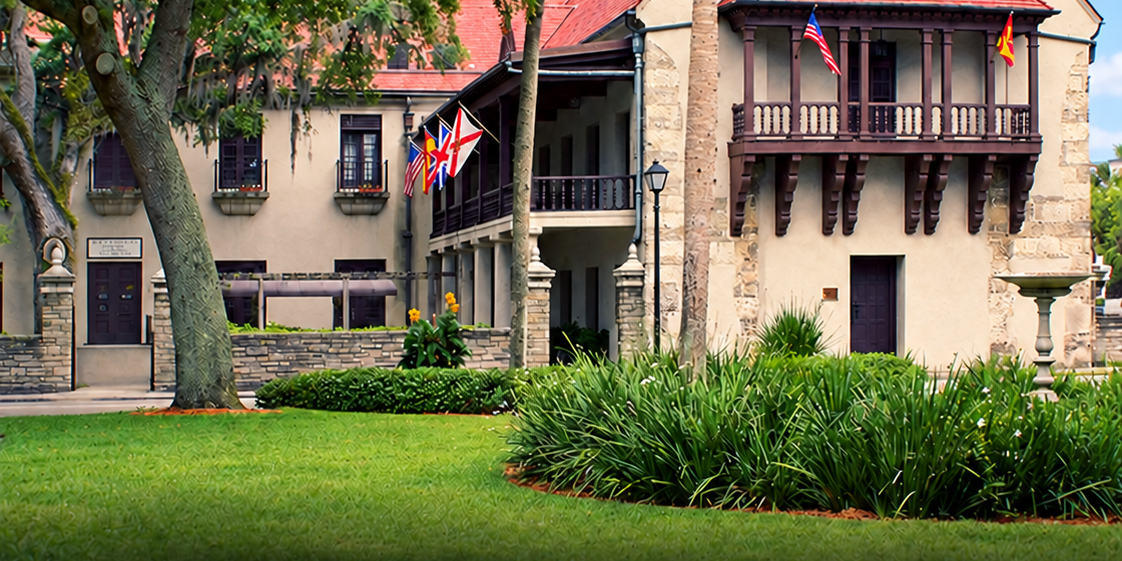
The recording happened at the Governor’s House in downtown St. Augustine, which is still standing. Governor Andrew Jackson had established the St. Johns County Clerk’s Office there earlier that year, the first clerk’s office in the Florida territory. Some of the office’s early recorded deeds are written in Spanish, which is what you would expect in a city that had been Spanish for most of the preceding 256 years.
Why one clerk’s office covered half of Florida
St. Johns County, as it existed in 1821, ran from the Suwannee River all the way down to Key West. Every deed, every court record, every transaction in that entire stretch of the territory came through St. Augustine. Just one office.
If you owned land near what is now Miami and wanted your deed on the public record, you traveled to St. Augustine. That is roughly 350 miles, and in 1821 there were no railroads in Florida and no paved roads.
Today, recording is a county function everywhere in Florida and most of it happens electronically. The reason for recording hasn’t changed. A recorded deed gives public notice of the transfer, so that anyone examining the property later can see who owns it and what claims exist against it.
How far back does a Florida title search go?
Thirty years, in most cases, under the Marketable Record Title Act at Chapter 712, Florida Statutes. Sometimes a bit more, but almost never going back 200 years.
Section 712.02 says that a person who has held an estate in land of record for 30 years or more has marketable record title, free and clear of claims except the ones listed in section 712.03. The starting point is called the root of title: the most recent title transaction affecting the property that was recorded at least 30 years before the date you’re examining it.
A worked example. You’re buying a house in Jacksonville and closing in 2026. We look for the most recent deed or other title transaction recorded on or before 2026 minus 30, so 1996 or earlier. Say that’s a warranty deed recorded in 1994. That deed is the root of title, and the search runs forward from there.
That is why 205 years of records don’t produce a 205-year title search. The statute cuts off most stale claims so that a transaction in 2026 doesn’t have to account for a dispute from 1890.
What survives a thirty-year search
Assume the thirty-year rule applies, but know that section 712.03 lists exceptions, and some interests survive regardless of how old they are.
One that matters to a lot of Northeast Florida homeowners: restrictions contained in the root of title have to be preserved by specific reference to the book and page where they are recorded, or by the name of the recorded plat. If nobody does that, the restrictions lapse after thirty years. That has real consequences for homeowners’ associations that never filed a preservation notice.
If you are signing or recording something
A deed runs a couple of pages and takes a few minutes to sign. Which deed you use, and how the ownership is written, decides what happens on the next transfer, what a creditor can reach, and whether the property passes the way an estate plan assumed it would. Those are hard to unwind afterward.
We handle Florida closings, title work, and deed preparation, and a chunk of what we do is untangling a deed that was recorded years ago by someone who picked the wrong form. If you have a document affecting your property in front of you, it is worth a call before it gets recorded rather than after.